Living with live oaks in Mobile
The live oak is the reason Mobile looks the way it does, and the reason the oaks are still standing after storms that put pines on roofs. Here is how to keep yours for another century, and what to do about the one limb over the roof.
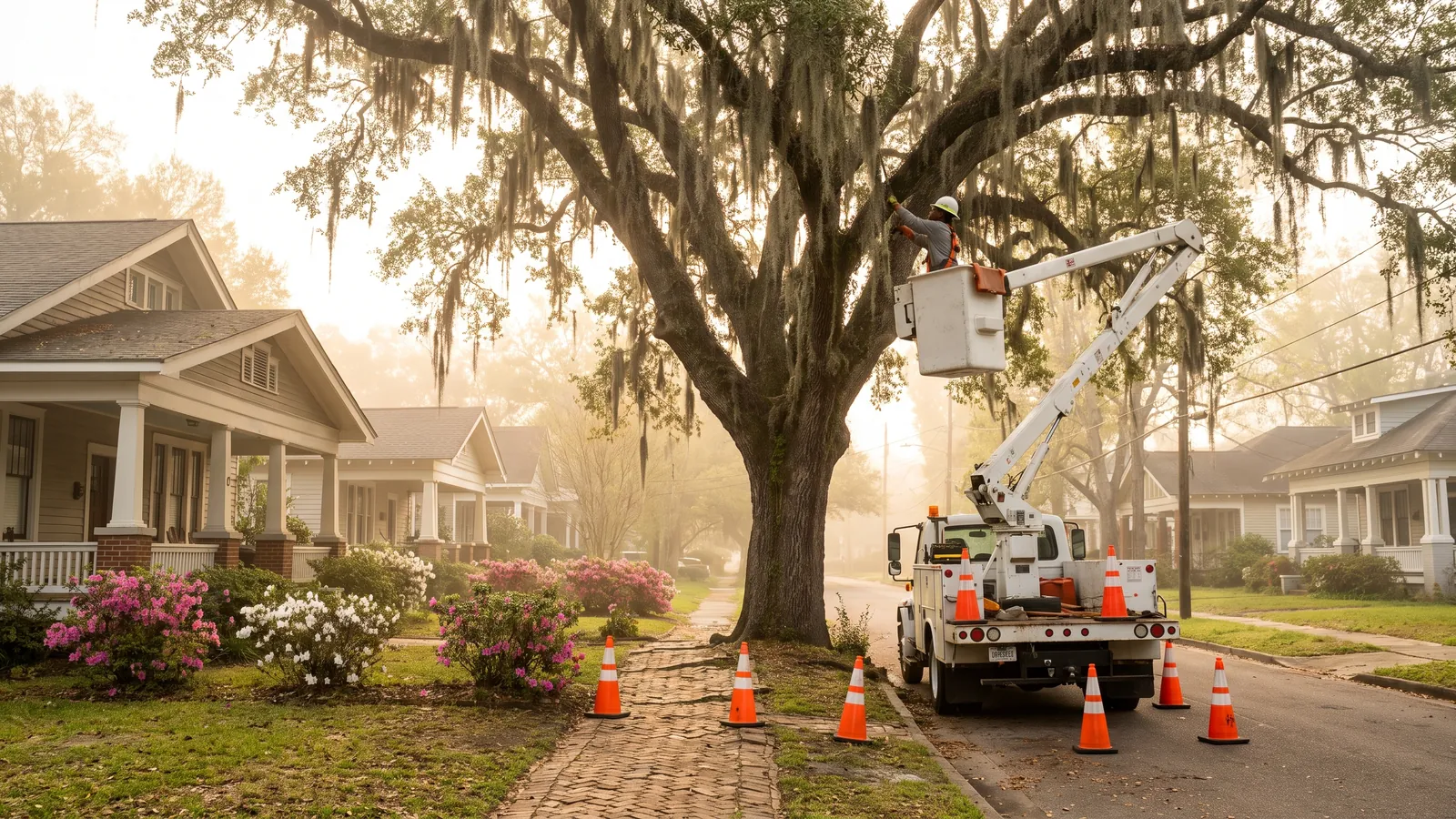
The survivor tree
Quercus virginiana, the southern live oak, is the tree the Gulf Coast is built around. It grows low, wide and dense, with limbs that run horizontal for 40 or 50 feet and a root system that spreads as far as the canopy. The University of Florida's hurricane research names it a survivor species, and Mobile proves it every few years: after Sally the oaks along Government Street and in the Oakleigh Garden District were standing while the pines were on the roofs. The city's oldest living landmark is one, the Duffie Oak in Midtown: about 300 years old, 30 feet 11 inches around at chest height, 48 feet tall and 126 feet across, recognized by the National Arborist Association in 1977 and by the Alabama Forestry Commission as a famous and historic tree in 2003. It was called the Seven Sisters Oak for its limbs before it was renamed for a mayor.
Where the risk actually is
A sound live oak almost never falls. What fails is a part of it: a long horizontal limb over the roof that has grown heavier every year, a co-dominant fork with included bark that cracks, a cavity in the trunk from an old wound, or roots cut on one side for a driveway, a sewer line or a pool. Hurricane damage to live oaks is mostly limbs, and most of those limbs could have been identified in a prep visit. The University of Florida's list of what makes a tree vulnerable (a high center of gravity, decay in the trunk, two or more trunks, shallow or severed roots) applies to live oaks exactly as much as to anything else; the species just starts from a stronger place.
Pruning a live oak
Good live oak pruning is almost invisible. Deadwood comes out. Limbs are lifted off the roof and the street with cuts at the branch collar, where the oak can close them. Over-extended limbs get reduction cuts at the ends, back to a side branch at least a third the diameter of what's removed, to bring the weight toward the trunk. The outer edge of the canopy is thinned where the wind loads it, never the interior. No more than about a quarter of the live canopy comes off in a year. The things that ruin a live oak are topping (cutting big limbs back to stubs, which rot and sprout weak growth), lion-tailing (stripping the inside of a limb and leaving a tuft at the end, which makes it more likely to break, not less), flush cuts into the trunk, and climbing spikes on a tree that isn't being removed. Late winter is the best time for heavy work, and before June 1 for hurricane prep. In the City right-of-way and inside the historic districts, pruning needs a Tree Commission permit and a certified arborist, and the permit is $75 per tree.
Fern, moss, mistletoe and ball moss
Resurrection fern and Spanish moss grow on live oaks everywhere in Mobile and take nothing from the tree; they're part of why the trees look the way they do, and the only reason to remove moss is weight on a limb that was already over-extended, in which case the fix is the limb. Ball moss is the same. Mistletoe is a parasite and worth cutting out of a stressed tree. Lichens on the bark are harmless.
Roots, driveways and construction
A live oak's roots run shallow and wide, and the surface roots that lift a driveway or a sidewalk are the same ones that hold the tree up in a hurricane. Cutting a root more than a few inches across within the dripline, or cutting roots on more than one side, turns a survivor into a hazard a few years later. Fill dirt piled over the root zone during a remodel, trenching for a sewer line or an irrigation system, and compaction from parked equipment do the same thing more slowly. If a driveway has to be rebuilt under an oak, bridge the roots or shift the slab; if a sewer line has to cross the root zone, bore it. Our arborist can mark the roots that can go and the ones that can't.
Hollow trunks and cabling
Old live oaks are often partly hollow and still perfectly sound; what matters is how much good wood is around the cavity. An arborist can sound the trunk, probe the cavity and tell you. A weak co-dominant fork can be braced with a steel rod through the union and a cable above it, which takes most of the risk out of the tree and keeps a landmark standing for a few hundred dollars more than a season's pruning. Cables need to be inspected every few years. Formosan termites nest in hollow oaks here; grinding out a nearby stump and calling a pest control company for the trunk are both worth doing.
When a live oak has to come down
It happens: a trunk that's lost most of its wood to decay, a fork that's split through, a tree planted ten feet from a foundation a century ago. A live oak removal is a serious job (dense wood, wide canopy, heavy pieces lowered over the house, often a crane) and in the right-of-way or a historic district it needs the permit and the certified arborist. We'll tell you when it's the answer, and we'll give you the pruning or cabling price first when it isn't.
Planting one
Give it 40 feet from the house and 25 from the driveway, well away from Alabama Power's 30-foot easement, on the high ground of the lot. Plant with the root flare at grade, in a wide shallow hole, and water it through the first two summers. In 40 years it will be the biggest thing on the block, and in 200 the reason someone moves to the street.
Common questions
Can a live oak fall in a hurricane?
A sound one, almost never. The failures are limbs, cracked forks, hollow trunks and trees whose roots were cut for construction. Those are all findable before the storm.
How much should I prune off?
No more than about a quarter of the live canopy in a year, and usually much less. Deadwood, clearance and a few reduction cuts on the limbs over the roof are a normal prune.
Does the Spanish moss hurt the tree?
No. Neither does resurrection fern or ball moss. Mistletoe is a parasite worth removing from a stressed tree.
Do I need a permit to prune or remove a live oak?
On a developed lot outside a historic district and off the right-of-way, no. In the right-of-way, yes. In a historic district, yes from 8 inches across. On an undeveloped lot, yes from 18 inches. It's $75 per tree and needs a certified arborist.
My live oak is lifting the sidewalk. What now?
If it's on the street side of the sidewalk, it's a City tree and the sidewalk is a 311 matter. On your side, the answer is usually to rebuild the walk over the root, not cut the root.
Is my hollow live oak dangerous?
Not necessarily. Many old live oaks are partly hollow and sound. An arborist can tell you how much good wood is left and whether a cable or a rod would help.
Related: Live oak pruning · Hurricane prep · Tree health · Tree permits · Tree planting