Land and lot clearing that keeps the trees worth keeping
A clean lot is easy. A cleared lot that still has its live oaks and its best longleafs, with the pines that would fall on the new house gone, takes some thought. We walk it with you and flag the keepers before the mulcher starts.
Mobile County is growing out, not up. Semmes was the county's fastest-growing city in the latest Census estimates, the 2023 annexation brought roughly 20,000 west Mobile residents into the city, and across the bay Baldwin County has three of the four fastest-growing municipalities in Alabama. Most of that growth is on land that was pine plantation, pasture or second-growth woods a few years ago. Clearing it is the first job on every one of those sites, and how it's done decides which trees are still standing after the first hurricane.
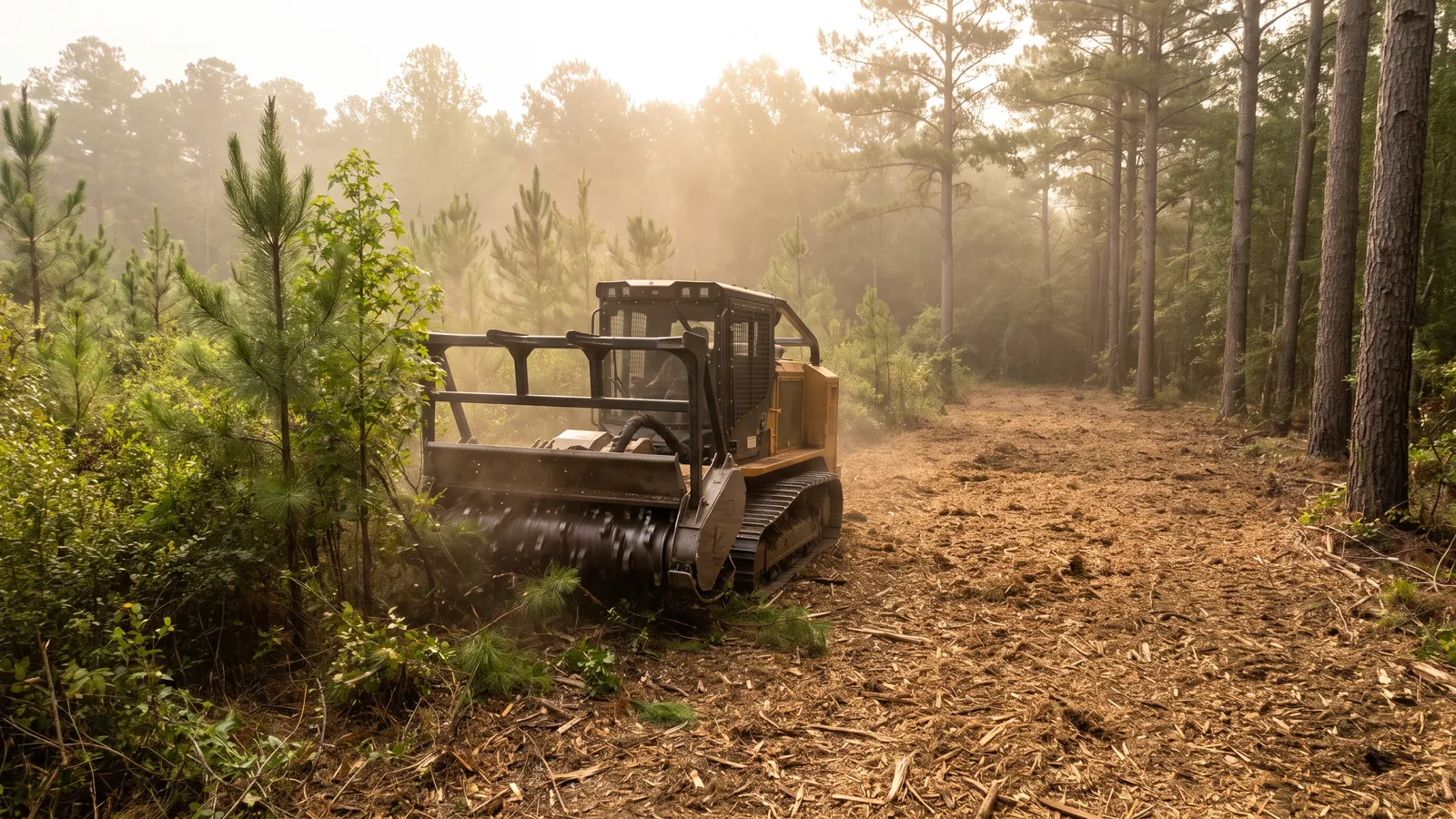
Our tool of choice is a forestry mulcher: a tracked machine with a drum head that turns underbrush, saplings, sweetgum thickets and small pines into mulch on the spot, with no burn piles, no haul-off and no stumps left to grind. For bigger timber we fell, buck and haul, or mulch the tops and sell or stack the logs. What we don't do is strip a lot bare by default. The University of Florida's hurricane research is clear that trees in groups resist wind better than lone trees, and that tall pines left standing alone after the stand around them is cleared are the ones that fail. So the plan for a home site is to keep the live oaks, magnolias and sound hardwoods in groups, take out the thin pines close to the building pad, and leave the longleafs that have room.
The rules are worth knowing before the first tree falls. Inside the City of Mobile, an undeveloped residential lot outside a historic district needs a Tree Commission permit for any live oak of 18 inches or more, and commercial property with an approved landscape plan needs a permit for Heritage Trees of 18 inches or more. On the Eastern Shore, Fairhope's Tree Ordinance No. 1444 requires a Landscape Plan approved by the City Horticulturist when tree removal is tied to a development or building permit, and Daphne and Spanish Fort have their own rules. We check the parcel, flag the protected trees, and pull what's needed. Alabama 811 is called before any stump is ground or any root is ripped, as the law requires.
What's included
Walk-through and keeper flagging
Live oaks, magnolias, sound hardwoods and well-spaced longleafs flagged to stay; thin pines near the pad flagged to go.
Forestry mulching
Underbrush, thickets and small trees mulched in place. No burn piles, no haul-off, no stumps.
Timber felled and hauled
Bigger pines and hardwoods cut, bucked and hauled or stacked; logs sold where there's value.
Permits and protected trees
City of Mobile live oak and Heritage Tree permits, Fairhope's landscape plan, checked and filed.
Alabama 811 before grubbing
Buried utilities located before any stump is ripped or ground.
Finished grade
Mulched smooth for a pasture or a yard, or stumps ground where the slab and driveway go.
Land clearing cost in Mobile, AL
| Job | Typical price | Notes |
|---|---|---|
| Forestry mulching, light brush | $1,500 – $3,000 per acre | Underbrush, saplings, trees under 6 in |
| Forestry mulching, heavy | $3,000 – $5,500 per acre | Thickets, trees 6–12 in, dense sweetgum |
| Home site clearing, ½ acre | $3,500 – $9,000 | Mulching plus selective pine removal |
| Selective pine removal on a wooded lot | $500 – $1,500 per tree | Near the building pad |
| Stump grinding for pad and drive | $150 – $450 per stump | Below grade |
| Fence line or right-of-way clearing | $4 – $12 per linear foot | Width and growth set the price |
These are 2026 Mobile-area ranges to help you budget. Your written price is itemized (climb or bucket work, rigging, chipping and haul-off, stump grinding, crane time, the City permit when one applies) and good for 30 days.
Recent work
Questions we get about land clearing
Do I need a permit to clear my lot?
In the City of Mobile, an undeveloped residential lot outside a historic district needs a Tree Commission permit for a live oak of 18 inches or more, and commercial sites with an approved landscape plan need one for Heritage Trees of 18 inches or more; other trees on a private lot generally don't. Fairhope requires a Landscape Plan when removal is tied to a building or development permit. Grading and stormwater permits are a separate question for your builder.
Mulching or hauling: which is better?
Mulching is faster, cheaper and leaves the mulch as ground cover that holds the sand in place. Hauling makes sense when you need a clean building pad, when there's timber worth selling, or when the material is diseased.
Can you leave the big pines?
You can, but think about which ones. A tall pine that grew in a stand and is now standing alone beside the house pad is the classic hurricane failure. Longleafs with a full crown and room around them are much stronger. We flag them tree by tree.
What about wetlands and the bay?
Clearing near wetlands, Dog River, Fowl River or the bay can involve the Corps of Engineers and ADEM. We'll tell you when a parcel looks like it needs that check before we start.
How long does it take?
A forestry mulcher clears about an acre of light brush in a day, less in heavy thickets. A half-acre home site with a dozen pines to remove is usually two or three days.
Can you clear a pasture that's grown up in sweetgum and pine?
That's the most common job we do in Semmes, Wilmer and the Eastern Shore. Mulched smooth, it can be bush-hogged the same season.